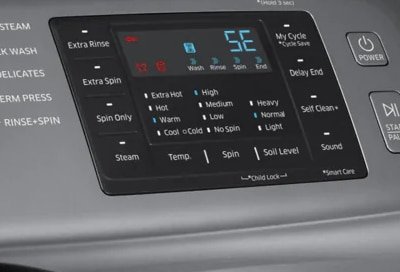
The most common reason a Samsung washer stops and shows a code is that it can’t drain the water inside it. That’s what 4C, 4E and 5E mean, and it’s the one you’ll see most often.
It’s safe to keep using the machine only if the drum is empty and the door opens normally. If water is still sitting in the drum, stop and fix the drain first.
The five-minute check: pull the washer out, look behind it, and see if the drain hose is kinked or pushed too far into the standpipe. If it’s jammed down tight, the pump pushes water up and straight back into the drum.
No kink, hose sitting right, and the drum still holds water? The blockage is past the hose, in the pump filter or the pipe itself, and that’s a different job.
Samsung washer codes and what they mean
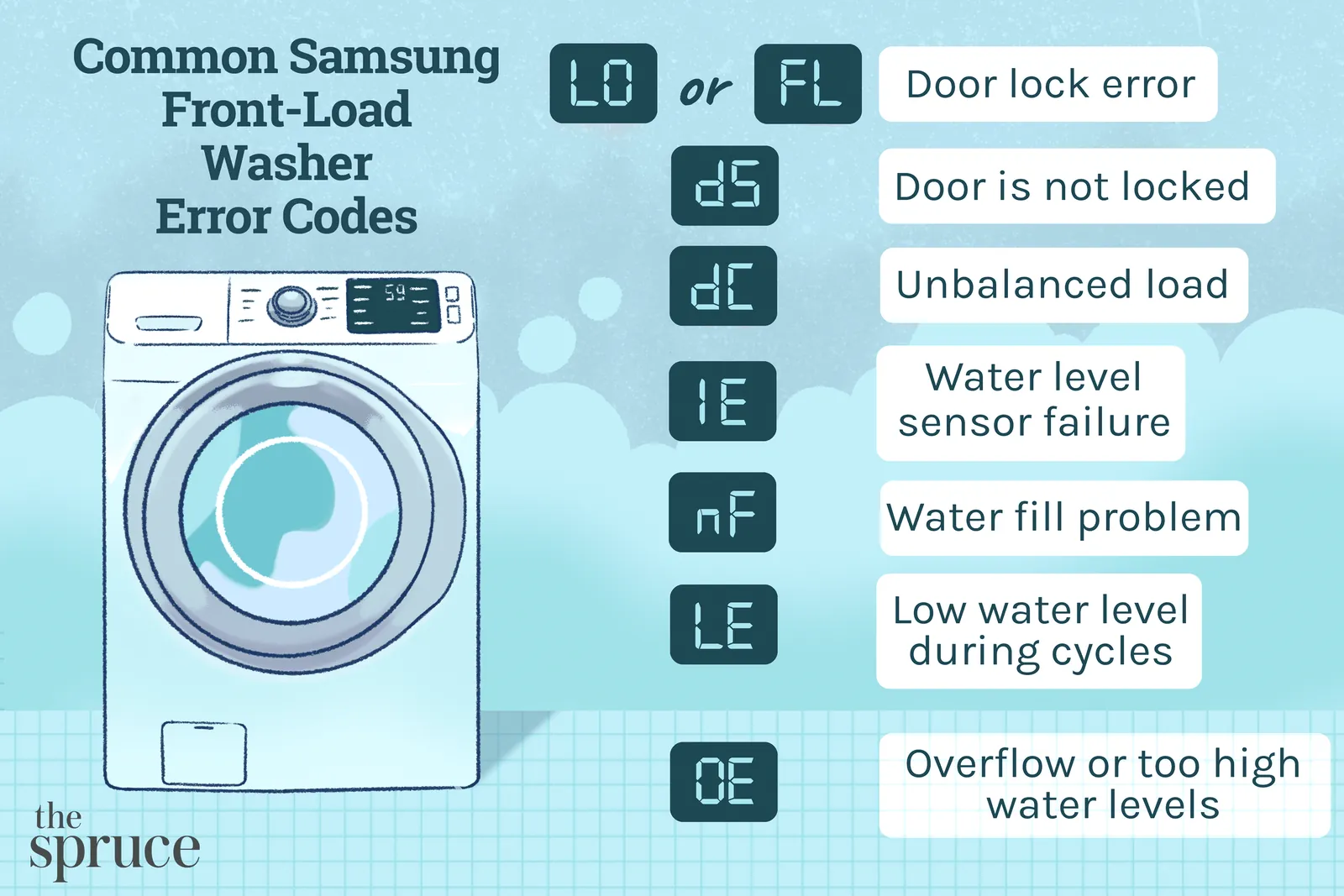
Samsung uses letters and numbers as short messages. A “4” or “5” at the start almost always points to water that won’t leave. A “U” points to an unbalanced load. A “dE” or “dC” points to the door. A “LE” points to the motor. Once you know the family a code belongs to, you know which part of the machine to look at.
The table below lists the codes you’ll actually see, what each one usually means, and the first thing to try. Work down it until you find your code.
| What you notice | What it usually means | What to do first |
|---|---|---|
| 4C, 4E or 5E, water left in drum | Drain is blocked or hose is kinked | Check the drain hose behind the machine |
| UE or UB, drum thumps | Load is bunched on one side | Stop it, open the door, spread the clothes |
| dE or dC, door won’t lock | Door isn’t shut or something is trapped | Push the door until it clicks |
| LE, drum won’t spin | Motor or hall sensor fault | Unplug for 10 minutes, then retry |
| Suds or SUdS on screen | Too much detergent | Run a rinse cycle with no clothes |
| 1E or E1, water won’t fill | Water tap is closed or inlet filter is clogged | Open the tap fully, check the inlet screen |
| 9E or E9, water never heats | Heating element or thermistor fault | Unplug for 10 minutes, then retry |
| tE or tE1, cycle stops early | Temperature sensor reading is wrong | Unplug for 10 minutes, then retry |
Most of these you can check yourself in under five minutes. The ones that need a technician are the motor and heating codes, and I’ll come to those.
Water won’t drain out
Water that stays in the drum is the number one cause behind a 4C, 4E or 5E code on a Samsung washer. The pump can’t push water out, so the machine stops mid-cycle and holds the door locked. It happens because lint, coins, hair and small items build up in the drain filter, or because the hose behind the machine is bent or blocked.
The confirming check takes under a minute and costs nothing. Pull the washer forward, look behind it, and run your hand along the drain hose. If it’s kinked, crushed against the wall, or pushed more than about 6 inches into the standpipe, that’s your problem.
The fix: straighten the hose, pull it back so only the last few inches sit inside the standpipe, then clean the drain filter. Most Samsung front loaders have a small door at the bottom front. Put a shallow tray and a towel underneath first, because water will come out. Unscrew the filter cap slowly, pull out any lint or coins, rinse it under a tap, and screw it back.
If the hose and filter are both clear and the code returns, the drain pump itself has likely failed. That’s a part swap, not a cleaning job.
The sign it worked: the machine drains within about 2 minutes of the drain phase starting, and the code clears on the next run.
The load is out of balance

A UE or UB code means the drum can’t spin evenly, so the washer stops to protect itself. It happens when heavy items like towels or jeans clump on one side of the drum, or when you wash a single bulky item alone. The machine tries to redistribute the load a few times, then gives up and shows the code.
The confirming check is simple: open the door and look. If everything is bunched against one side, or you can see one heavy item sitting alone, that’s the cause. No tools needed.
The fix: pull the items out, shake them loose, and put them back spread around the drum. Add one or two similar items if you’re washing something bulky alone. Close the door and restart the cycle.
The sign it worked: the drum spins up smoothly through the spin phase without stopping, and the code doesn’t come back.
How to tell this apart from a drain problem: a drain fault leaves water sitting in the drum, and a balance fault doesn’t. If the drum is empty of standing water but the machine still won’t spin, it’s balance, not drainage.
The door isn’t locking
A dE or dC code means the door lock isn’t engaging, so the machine won’t start. It happens when the door isn’t pushed fully shut, when a piece of clothing is trapped in the seal, or when the latch itself has worn out. It’s the least common of the three, but it’s the easiest to rule out.
The confirming check: open the door, look at the seal all the way around, and pull out anything caught in it. Then close the door firmly and listen for the click. If you don’t hear it, the latch isn’t catching.
The fix: clear the seal, push the door until it clicks, and start a short cycle. If the door still won’t lock, unplug the machine for 10 minutes and try again. A power reset clears a stuck control board often enough to be worth the two minutes.
The sign it worked: the door locks with a click and the cycle starts within a few seconds.
How to tell this apart from the first two causes: this code appears before any water enters the drum. If the machine never filled, it’s the door, not drainage or balance.
When to stop and call a technician
Some codes mean the problem is inside the machine, and that’s where your own work ends. Stop and call a qualified technician if you see any of these:
- LE code that returns after a power reset. The motor or its sensor has failed. This is a technician job.
- 9E or E9 code that returns after a power reset. The heating element or its sensor has failed. Same rule.
- Water leaking from under the machine. A seal or hose inside has split. Unplug it and call someone.
- Burning smell, sparks, or a tripped breaker. Stop using the machine immediately and unplug it.
- The drum won’t turn by hand when the machine is off. Something inside has seized.
One test separates a nuisance code from a real fault. Reset the machine once, then run the same cycle again. If the code stays away through a full wash, note the date and carry on. If it comes back on that second run, stop there. Repeating the reset five or six times doesn’t clear a failed sensor, and each attempt spins a damaged motor or heater a little closer to a much larger bill.
Never open the machine’s housing, touch the control board, or test any internal part yourself. Only a trained technician with the right tools should open it.
Call Samsung support or a certified repair service instead. Have the model number and the exact code ready before you call, since that’s the first thing you’ll be asked for.
Frequently asked questions
What does 4C mean on a Samsung washing machine?
4C means the washer can’t drain the water out. Check the drain hose behind the machine for kinks, then clean the drain filter at the bottom front. If both are clear and the code comes back, the drain pump has likely failed and needs replacing by a technician.
Is it safe to keep using my Samsung washer with an error code?
It’s safe only if the drum is empty and the door opens normally. If water is sitting in the drum, or you smell burning, or the breaker tripped, unplug the machine and don’t run it again until it’s fixed. Water plus electricity is the risk you’re avoiding.
How long does a Samsung washer take to drain?
If yours takes longer, or the code appears before draining finishes, the filter or hose is partly blocked. Clean both and time the next cycle to compare.
Can I reset a Samsung washing machine error code?
Yes. Unplug the machine for 10 minutes, then plug it back in. This clears most temporary codes, including balance and sensor faults. If the code returns on the very next cycle, the problem is real and needs a proper fix, not another reset.
What does UE mean on a Samsung washer?
UE means the load is out of balance and the drum can’t spin evenly. Open the door, spread the clothes around the drum, and add a similar item if you’re washing something bulky alone. Restart the cycle and the code should clear.
What happens if I ignore a Samsung washer error code?
The machine stops mid-cycle and holds the door locked until the fault clears. Ignoring it won’t damage the washer right away, but running it with a blocked drain or a failed pump can lead to leaks and water damage over time. Fix the cause, don’t just clear the code.
Does it matter which Samsung error code I get?
Yes, because each code points to a different part of the machine. A 4C points to drainage, a UE points to balance, and an LE points to the motor. Matching the code to the right cause saves you from replacing a part that was never broken.
Why does my Samsung washer show a code only sometimes?
Intermittent codes usually mean a partial blockage or a load that’s only sometimes unbalanced. A drain filter that’s half-clogged may only fail on heavy cycles. Clean the filter and hose fully, then watch whether the code returns on the same cycle type.
Conclusion
A code is just the machine telling you which part of the cycle failed, and most of the time it’s pointing at water, balance, or the door. Start with the drain hose and filter, because that’s where the answer usually is. If the code points inside the machine, put the tools down and call someone who’s trained for it.