
Most of the time, a Samsung fridge that won’t dispense cold water has a frozen water line behind the wall, or the dispenser is locked. In a small number of cases, the water filter is clogged or the line is kinked. The fastest check: press and hold the Child Lock or Lock button for 3 seconds, then try again. If the panel beeps and the lock icon clears, that was it.
Why your Samsung fridge won’t dispense cold water

Water has to travel from your home supply, through a filter, up a line, and out a paddle. Any stop along that path gives you the same symptom: nothing comes out, or it comes out in a weak trickle. Here’s how the causes rank.
| Cause | How common | How to confirm it | Fix it yourself? |
|---|---|---|---|
| Frozen water line | Very common | No water, but ice maker works | Yes, with care |
| Dispenser locked | Very common | Lock icon on the panel | Yes |
| Clogged water filter | Common | Slow flow, odd taste | Yes |
| Kinked or pinched line | Sometimes | Weak flow after moving fridge | Yes |
| Water supply valve off | Sometimes | No water at all, no sound | Yes |
| Bad dispenser switch | Less common | No click, no sound | No |
| Failed inlet valve | Less common | No hum when paddle pressed | No |
Work down the list. The top two causes explain most cases, and both take under five minutes to check.
A frozen water line behind the fridge wall
A frozen line is the single most common reason a Samsung fridge stops giving cold water. The line runs through the door and up into the freezer area. Cold air seeps in around it, and the water inside freezes solid. The ice maker still works because it uses a different path.
How to confirm it: Pull the fridge out and check the water line where it enters the door. If the line feels hard or you see frost near the door hinge, it’s frozen.
The fix, step by step:
- Unplug the fridge, or switch off the breaker.
- Open both doors and leave them open for 2 to 4 hours. A hair dryer on low, held 6 inches from the line, speeds this up — never use high heat.
- While it thaws, check the freezer temperature. It should sit at 0°F. Warmer than that and food safety suffers; much colder and the line may refreeze fast.
- Plug it back in and wait 2 hours before testing the dispenser.
This costs you a few hours of waiting, not money. If the line refreezes within a week, the door seal or the temperature setting is the real problem, and that’s a different job.
When the dispenser is locked or in a locked mode
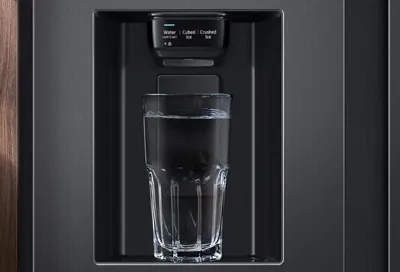
Samsung fridges have a control lock that stops the dispenser and the ice maker at the same time. It’s easy to switch on by accident when you’re wiping the panel. This cause looks identical to a frozen line from the outside — you press the paddle and nothing happens.
How to tell it apart from a frozen line: Press the paddle. If you hear the fridge hum or click but get no water, it’s likely frozen. If you hear nothing at all and the panel shows a lock icon, it’s the lock.
Some models don’t show a lock icon at all. On those, the tell is the ice maker: if it also stopped at the same moment the water did, the lock is the cause. A frozen line kills the water only, and the ice maker keeps cycling.
The fix:
- Find the Lock or Child Lock button — usually top left of the panel.
- Press and hold it for 3 seconds.
- Wait for the lock icon to disappear or the panel to beep.
- Press the paddle again.
If the lock won’t clear, check the child lock in the SmartThings app before you touch the fridge. A lock set there overrides the panel button, so holding it does nothing.
If the panel is unresponsive and the lock won’t clear, unplug the fridge for 5 minutes and plug it back in. A control board that stays dead after that needs a technician.
A clogged water filter or a kinked line
A clogged filter cuts flow slowly, so you notice a weak stream before you notice nothing at all. How often you change the filter depends on your use, and the owner’s manual is the authority. The filter sits inside the fridge, usually top right or in the left crisper area, depending on the model.
How to confirm it: Pull the filter out and try the dispenser. If water flows without the filter in place, the filter was the block. Don’t run it that way for long — with the filter out, water flows unfiltered through the housing on some models.
The fix: Twist the old filter a quarter turn to release it, fit the new one, and run 2 to 3 gallons through the dispenser to flush it. That’s about 3 to 4 minutes of holding the paddle. The first glass may look cloudy — that’s trapped air or carbon dust from the new filter, not a fault.
A kinked line gives the same weak flow. Check behind the fridge for a line pinched against the wall. Straighten it and test again. If the line is cracked, it needs replacing — a short job for a technician, and one that can leak if rushed.
Rare causes worth a quick check
The remaining causes are uncommon, but each has one clue that points to it.
- Water supply valve turned off. Look under the sink or behind the fridge. If the valve handle is across the pipe, not along it, the water is off. Turn the handle a quarter turn to open it and try the dispenser again.
- Bad dispenser switch. No click and no hum when you press the paddle. This is a technician job — the switch sits behind the panel.
- Failed inlet valve. The fridge stays silent when you press the paddle. Also a technician job, and it needs the water shut off first.
- Household water pressure too low. Weak flow from every tap in the house points here. Check with your water provider.
- Control board fault. The panel lights up but nothing responds, even after a reset. This needs a qualified technician.
Two of these are worth ruling out before you call anyone, because they cost nothing to fix. The supply valve takes a minute, and low house pressure is confirmed at the kitchen tap, not at the fridge.
If the kitchen tap runs strong and the valve is open, the fault is inside the fridge. Stop there and book the visit.
Parts that involve the control board and wiring aren’t a do-it-yourself job. Unplug the fridge before anyone opens a panel, and hand that work to a technician.
What fixing this actually asks of you
Most fixes here are cheap in money and heavy in patience. The lock reset takes seconds. Thawing a frozen line costs you 2 to 4 hours of waiting, plus the time to pull the fridge out and put it back. A new filter is a small, regular purchase — the same size as a few jugs of bottled water. A kinked line is free if you can reach behind the fridge.
Before you start any of it, check the shutoff valve behind or under the fridge. If it’s stiff or dripping, turning it can turn a five-minute job into a flooded floor and a plumber’s bill. If it won’t close cleanly, stop and call someone.
The inlet valve and dispenser switch are the real costs. Those need a technician, and the price depends on your model, your area, and whether the part is in stock. Get a quote before you agree to anything, and ask whether the call-out fee comes off the repair.
One more thing worth asking: whether the technician carries the part on the first visit. If not, you’re paying a second call-out for the same repair.
For the exact filter your model takes, check the label inside the fridge door or the Samsung support page for your model number.
Related guides
Frequently asked questions
How long does it take to thaw a frozen water line?
It takes 2 to 4 hours with the doors open and the fridge unplugged, or about 30 to 45 minutes if you use a hair dryer on low. The time depends on how much ice has built up and how cold your freezer runs. If it refreezes within a week, the freezer is set too cold.
Why does my Samsung fridge dispense water but not cold water?
The water sits in a tank or coil inside the fridge, so it should come out cold. If it’s warm, the fridge hasn’t run long enough after being plugged in, or the tank is in the door and the door is warm. Give it 2 hours of running time first.
Is it safe to drink water from a fridge that hasn’t been used in months?
No, not straight away. Run 2 to 3 gallons through the dispenser first and fit a new filter. Standing water in the line and tank can pick up taste and odor. If the fridge sat unplugged, flush the line and tank and clean the dispenser area before use.
Can I use my Samsung fridge without the water filter?
Yes, on most models the dispenser still works with the filter removed, but you lose filtration. Some models need a bypass cap to keep water flowing. Check your manual, and don’t leave it that way long-term.
What happens if I press the dispenser and hear nothing at all?
Nothing at all usually means the lock is on, the power is off, or the dispenser switch has failed. Check the lock icon first, then the outlet and breaker. If the panel is lit and the lock is off, it’s a technician job.
Does the water filter affect the ice maker too?
Yes, on most Samsung models the same filter feeds both the dispenser and the ice maker. If ice production dropped at the same time as water flow, the filter is the likely cause. Change it and flush both.
How often should I change the Samsung water filter?
How often you change the filter depends on your use, and the owner’s manual is the authority. Hard water and heavy use shorten that. If your water tastes odd or the stream weakens early, change it early. The exact interval is on the filter packaging.
Can a frozen line damage the fridge?
A frozen line itself usually won’t damage the fridge, but expanding ice can crack the plastic housing or the line. If you see water pooling inside the fridge or on the floor after thawing, stop and call a technician. That points to a cracked line or housing.
Conclusion
If none of that gets the water flowing, it’s time to call a technician—you’ve likely got a bad inlet valve or a control board issue that needs a pro’s hands. Don’t keep guessing at it. Book a service visit, and you’ll have cold water again before you know it.