
Cleaning an oven quickly takes about 30 minutes of hands-on work for a light, greasy oven, and 1 to 2 hours if you use a chemical oven cleaner that needs dwell time. Most of that second number is waiting, not scrubbing. The job is easy to medium — the inside walls are easy, the door glass and the racks need care. You’ll need one thing before you start: the make and model number of your oven, so you can check what your manufacturer says about cleaning it.
Cost is small if you use baking soda, vinegar and dish soap you already own. A commercial oven cleaner costs more, and prices vary by brand and country, so check the shelf price where you shop. For the exact cleaning instructions and any parts you must not touch, read your oven’s manual or the maker’s official page — that’s the only source that knows your model.
What you need to clean an oven fast

| Item | How much | Why it’s needed | A substitute |
|---|---|---|---|
| Baking soda | 1/2 cup (120 g) | Lifts baked-on grease | None — don’t swap this |
| White vinegar | 1 cup (240 ml) | Rinses residue away | Lemon juice, same amount |
| Dish soap | 2 teaspoons | Cuts fresh grease | Any grease-cutting soap |
| Spray bottle | 1, 500 ml | Applies vinegar evenly | Clean cloth dipped in vinegar |
| Rubber gloves | 1 pair | Protects hands from cleaner | None — don’t swap this |
| Plastic scraper | 1 | Lifts soft crust without scratching | Old credit card |
| Microfiber cloths | 3 | Wipe, rinse, dry | Cotton rags, lint-free |
If you use a commercial oven cleaner instead of baking soda, the amount changes — follow the dose printed on that product’s label, because strengths differ between brands.
Before you start cleaning your oven
- Switch off and unplug the oven. If it’s a gas oven, turn the gas supply off at the valve. Let the oven cool completely — a hot oven can burn you and hot surfaces make the cleaner fume.
- Empty everything out. Remove racks, trays, and any foil. Foil left on the floor traps heat and can damage the finish.
- Move what’s around it. Push chairs back, and open a window or turn on the extractor fan. Oven cleaner fumes are strong, and the room needs airflow.
- Cover the floor and the oven door. A towel or newspaper under the oven catches drips before they set on your floor.
- The step most people skip: checking the manual first. Some ovens have a self-clean setting, and some have parts — like the door seal or the heating element — that the maker says not to spray.
One limit worth naming: if the door glass is cracked, stop here. That’s a job for a qualified appliance technician, not a DIY clean.
How do you clean an oven quickly?
-
Make the paste. Mix 1/2 cup baking soda with 2 to 3 tablespoons of water until it’s the texture of thick toothpaste. Too runny and it slides off the walls; too dry and it won’t lift grease. You’ll know it’s right when it holds a ridge on the spoon.
-
Spread it on the grease. Put on gloves and smear the paste over the inside walls, the floor and the door glass. Skip the heating element and the fan cover. It should look like a thin coat of frosting, not a thick cake.
-
Let it sit. Wait 20 minutes for light grease, or overnight for heavy, baked-on crust. The paste works while you do something else. You’ll know it’s ready when the paste has dried to a chalky white and feels hard to the touch.
-
Wipe the loose paste off. Use a damp microfiber cloth and wipe in circles. Don’t scrub hard yet. You should see brown grease coming away on the cloth — that’s the sign the paste did its job.
-
Spray the vinegar. Fill the spray bottle with 1 cup white vinegar. Spray the leftover paste film. It’ll fizz on contact as the acid neutralizes the baking soda, which helps loosen the residue so you can wipe it away.
-
Wipe again and rinse. Wipe with a clean damp cloth until no white film is left. Two passes are usually enough. If the cloth still comes away chalky, rinse once more — dried baking soda leaves a haze on the glass.
-
Clean the racks separately. Soak them in hot water with 2 teaspoons dish soap for 30 minutes, then scrub with a plastic scraper. Never put racks in a dishwasher unless the manual says they’re dishwasher-safe.
-
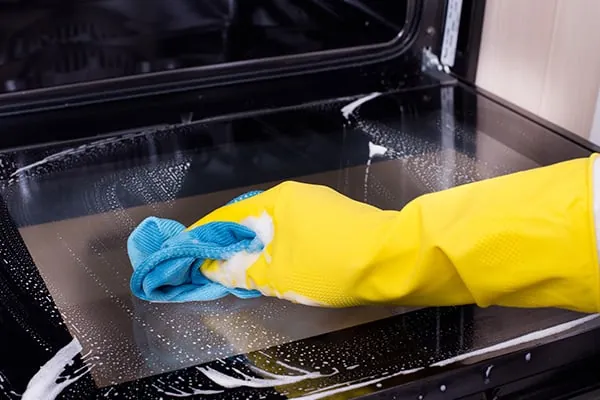
Do the door glass inside and out. Use the vinegar spray and a microfiber cloth. Between the glass panes, leave it alone — that gap is sealed, and taking the door apart is technician work.
-
Dry everything. Leave the door open for 15 minutes with the oven off. Leftover moisture and residue can cause odors and uneven baking next time.
-
Run a short empty heat if needed. If any residue remains, heat the empty oven at 350°F (175°C) for 15 minutes. If your oven runs hotter or cooler than the dial says, check its own display or manual for the true temperature.
How to know the oven is actually clean
The oven is clean when a white cloth wiped across the floor and walls comes away with no grey or brown marks. That’s the check that matters — not how it looks from the doorway. Run your cloth along the back wall and the corners, where grease hides. If the cloth is still dirty, the paste needs another round.
A second sign: the oven door glass should be clear enough to read through with the light on. Cloudiness means dried baking soda film, not grease, so rinse rather than scrub.
Signs it needs another round: grease that’s still tacky to a gloved finger, a dark ring around the door seal, or a smell when you open the door cold. For heavy crust, repeat steps 2 and 3 with a fresh paste and leave it overnight. Never use a metal scraper or steel wool — they scratch the enamel permanently, and a scratched oven traps grease faster next time.
How long the paste needs depends on how hot your oven runs and how often you cook meat and oil. An oven used daily for roasting needs the overnight dwell; one used twice a week for baking usually clears in 20 minutes.
If something goes wrong
| What happened | Why | What to do |
|---|---|---|
| White film on the glass | Dried baking soda residue | Rinse with vinegar, wipe again |
| Paste won’t come off | Left on too long, baked hard | Spray vinegar, wait 10 minutes |
| Strong fumes in the room | Oven cleaner, poor airflow | Open windows, leave the room |
| Scratches on the enamel | Metal scraper or steel wool | Stop — damage is permanent |
| Door seal looks worn | Age and heat cycles | Replace it, don’t clean it |
| Oven still smells when hot | Residue in the vents | Wipe vents, run empty heat 15 minutes |
If you used a commercial cleaner, follow the maker’s first-aid advice printed on the label, and call your local poison control center if it gets on skin or in eyes.
How often to clean an oven

Clean the oven every 3 months if you cook with oil and meat several times a week. For light use — baking once or twice a week — every 6 months is enough. Those intervals assume a standard home oven used for normal cooking; a commercial-style range or one used for daily roasting needs a quick wipe every month.
Two things move that number most. First, what you cook: roasting, grilling and frying throw far more grease than boiling or steaming, so heavy roasting pushes you toward the 1-month end. Second, how often you cook: more cooking sessions mean more grease on the walls, and baked-on crust takes longer to lift later.
You don’t have to guess. Look at the oven floor after a cooking session — if you can see a grease sheen while it’s still warm, that’s your cue for a 10-minute wipe now, which saves you a full clean later.
Frequently asked questions
How long does it take to clean an oven?
About 30 minutes of hands-on work for a light oven, plus 20 minutes of dwell time for the baking soda paste. Heavy, baked-on grease needs an overnight dwell, so plan 1 to 2 hours total across two days. A commercial oven cleaner usually needs 20 to 30 minutes of contact time — check that product’s label, since brands differ.
Can I clean an oven without chemicals?
Yes. Baking soda, water, white vinegar and a little dish soap clean most home ovens. The paste does the lifting and the vinegar rinses it away. For heavy crust, the overnight dwell does the work instead of strong chemicals. You’ll still want gloves and good airflow, because even vinegar fumes build up in a closed kitchen.
Is it safe to use the self-clean setting?
It’s safe if your manual says your model has it, but it runs at very high heat for 2 to 4 hours and produces smoke and fumes. Open windows, remove the racks first, and stay home while it runs. Many makers advise against self-clean for ovens with certain door seals — your manual is the only place that answers this for your model.
What happens if I get oven cleaner on my skin?
Rinse with cool water for 15 minutes and remove any clothing the cleaner touched. Caustic oven cleaners can burn skin, so read the first-aid steps on the product label and call your local poison control center if the burn blisters or the area stays painful. Keep the label with you when you call.
Does baking soda damage the oven?
No. Baking soda is mild and won’t harm enamel or stainless steel at the amounts used here. The real risks are metal scrapers and steel wool, which scratch the finish permanently. Keep the paste away from the heating element and the fan, and wipe it all off before you heat the oven again.
Why does my oven still smell after cleaning?
Residue left in the vents, the door seal or the corners is usually the cause. Wipe those spots with a damp cloth, then heat the empty oven at 350°F (175°C) for 15 minutes with a window open. If the smell continues after two rounds, the residue may be behind a panel — that’s a job for a technician.
Can I clean the oven racks in the dishwasher?
Only if your oven manual says the racks are dishwasher-safe. The detergent and high heat can dull the chrome finish on some racks. If you’re not sure, soak them in hot water with 2 teaspoons of dish soap for 30 minutes and scrub with a plastic scraper instead.
How do I keep the oven clean longer?
Wipe the floor with a damp cloth while the oven is still warm but switched off, about once a week. Covering dishes when you roast cuts the grease that lands on the walls.
Conclusion
Once your oven’s clean, keep it that way with a quick wipe after messy meals, before spills bake on. If you haven’t checked your manual yet, do that today — it’ll tell you which cleaners are safe for your model. A little upkeep now saves you another big scrub later.