
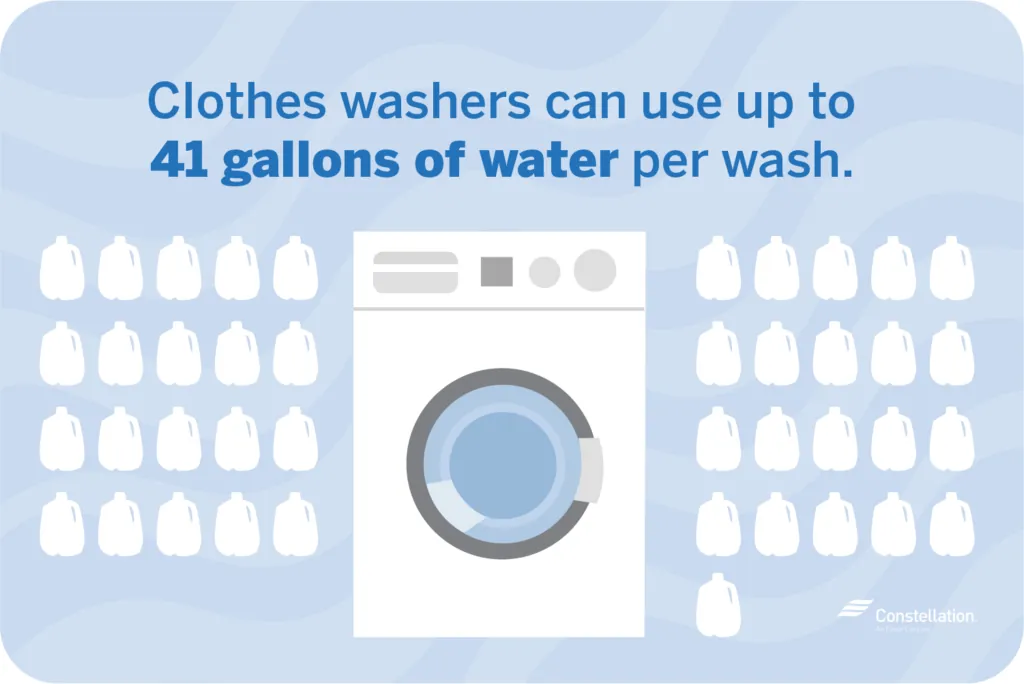
A typical household washing machine uses about 19 to 30 gallons of water per load, depending on its age, size, and cycle setting. A modern front-loader sits at the low end, around 13 to 15 gallons for a full drum. An older top-loader with a full tub can pass 40 gallons on the same wash.
Cycle choice moves the number as much as the machine does. Most washers default to a deep fill or a bulky setting, and switching to the normal or eco cycle on the same load can cut several gallons without a visible difference in how clean the clothes come out.
The setting that quietly costs the most is the water level. On a top-loader, leaving it on high for a half-full drum wastes roughly the difference between the two fills every single wash. Match the level to the load size, or let the machine sense it if it has that option.
Washing machine water use at a glance
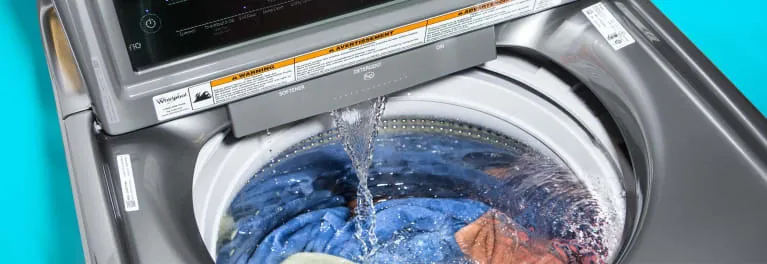
- Front-loaders use the least. Most models run 13 to 20 gallons per full load because the drum tips clothes through a shallow pool instead of soaking them.
- Top-loaders use more. A standard top-loader runs 25 to 40 gallons per full load; high-efficiency top-loaders with no central agitator sit near 20 to 25.
- Cycle choice moves the number. A Normal cycle uses the full amount; Quick Wash and Eco modes cut it by roughly a third on most machines.
- Load size sets the fill. Many machines auto-sense the load and fill only as deep as the clothes need, so a half load can use about half the water.
- An extra rinse adds a full rinse cycle. That’s usually 5 to 10 gallons more, so skip it unless someone in the house has a skin condition.
- Your water bill shows the truth. Divide the gallons on your bill by the number of loads you ran that month to get your real per-load figure.
Why front-loaders use so little water
A front-loader cleans by lifting clothes to the top of the drum and dropping them back into a shallow pool at the bottom. Every drop touches fabric many times, so the machine needs far less water to do the same job. A top-loader works the other way: the drum sits vertically and the clothes float in a deep tub, which is why the fill level is so much higher.
This is also why the two types don’t wash the same way. A front-loader relies on mechanical tumbling and a small amount of concentrated detergent. A top-loader relies on volume and agitation. If you pour the same amount of detergent into both, the front-loader will struggle to rinse it out — too much soap in too little water leaves residue on the clothes and inside the drum.
The U.S. Environmental Protection Agency runs the WaterSense program, which labels products that use at least 20 percent less water than the federal standard. The EPA WaterSense product page explains which appliances carry the label and what the label actually guarantees.
Water use per load doesn’t tell the whole story either. A machine that uses 15 gallons but needs two cycles to get clothes clean uses more than a 25-gallon machine that finishes in one pass. That’s the trade-off most buyers miss: the lowest gallon figure on the spec sheet only wins if the wash is done in a single cycle.
When your machine uses more or less
| Situation | What changes | What to do instead | |—|—|—|—| | Small load, big drum | Machine fills to load size | Use the Small or Auto setting | | Bulky items like comforters | Water can’t circulate | Run a Bulky cycle, one item | | Extra rinse selected | Adds 5 to 10 gallons | Turn it off unless needed | | Old machine, 15+ years | No load sensing at all | Run full loads only | | Cold wash chosen | Water volume stays same | Saves energy, not water | | Heavily soiled work clothes | May need a second wash | Pre-treat, then one cycle |
The pattern in that table is simple: the machine fills to the load, then adds water for whatever extra step you selected. Cut the extra steps and the gallons drop.
Two rows are easy to misread. Cold wash isn’t a water-saving choice, so if your goal is a lower water bill, cold does nothing for you. It cuts the energy used to heat the water, which is a different bill.
An old machine is the opposite case. Without load sensing it fills to a fixed level no matter what you put in, so a half load wastes half the water. On those machines, wait and wash everything together.
If your machine has a Small setting and you’re washing three shirts, use it. If it does not, and the drum is more than about half empty, save the load for later.
Pre-treating is the cheapest fix on the list. A stain treated before the wash usually comes out in one cycle, and a second wash costs you a full fill.
How to cut water use per load
- Sort by fabric weight, not just color. Heavy items like towels and jeans need more water to move freely than light shirts. Washing them together forces the machine to fill for the heaviest item, so a mixed load wastes water on the light pieces.
- Fill the drum, don’t stuff it. A front-loader works best when the drum is about three-quarters full — clothes should tumble freely when you push them. Overloading stops the tumbling action and the wash comes out still dirty, so you run it again.
- Match the cycle to the soil level. Lightly worn clothes need a Normal or Quick cycle, not Heavy Duty. Heavy Duty adds time and often an extra rinse, which is 5 to 10 gallons you didn’t need to spend.
- Skip the extra rinse unless there’s a reason. An extra rinse is for detergent sensitivity or very soapy loads. If your clothes feel stiff or smell like soap, use less detergent instead of adding a rinse cycle.
- Use the right detergent amount. High-efficiency machines need HE detergent, and the cap line is usually smaller than people think. Too much soap means the machine may run an extra rinse on its own to clear the suds.
- Run full loads when you can. Two half loads use more water than one full load on almost every machine. Wait until you have a full drum of similar fabrics before you start a cycle.
- Check the water level setting on a top-loader. If your machine has a manual dial, set it to match the load. Leaving it on the highest setting for a small load is the single easiest way to waste 15 gallons.
- Read your machine’s manual for the exact figures. The manual lists gallons per cycle for each setting on most models made after 2010. If you can’t find it, run a load and check your water meter before and after.
Mistakes that waste water
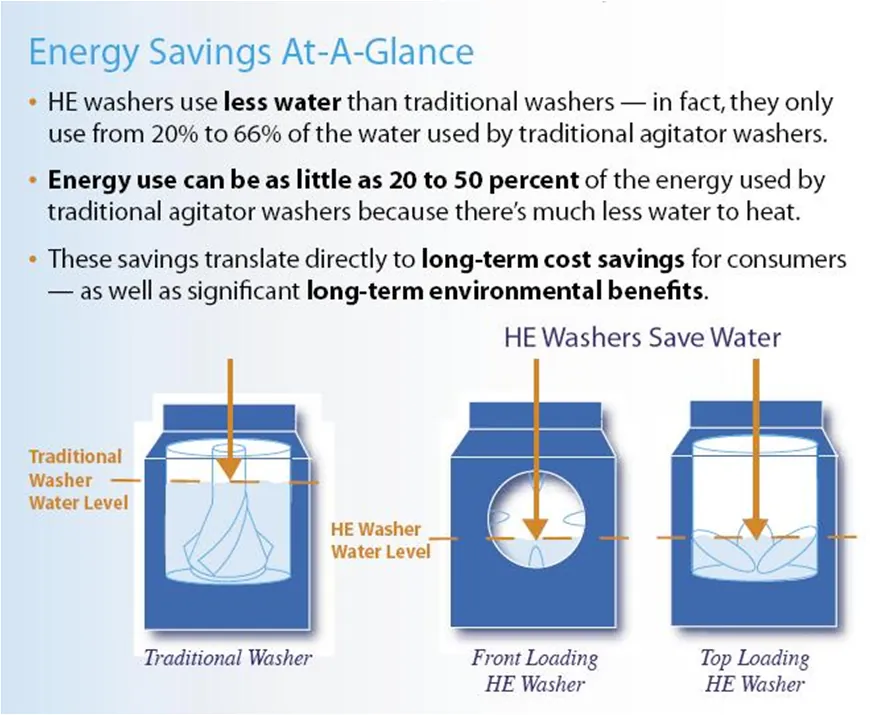
- Leaving the water level on max for every load. A top-loader set to the highest fill for a small load can use two to three times the water that load actually needs, every single time.
- Adding an extra rinse out of habit. That rinse costs 5 to 10 gallons and does nothing unless detergent is actually left in the fabric. If clothes feel stiff, the fix is less soap, not more water.
- Overloading to “save” a load. A stuffed drum can’t tumble, so the wash comes out dirty and gets run again — two full cycles instead of one.
- Ignoring a leaking door seal or hose. A slow drip under the machine can lose more water in a week than a whole load uses. Check the floor under the drum after each wash.
- Using non-HE detergent in a high-efficiency machine. Too many suds trigger extra rinse cycles the machine adds on its own, so the water saving disappears.
Frequently asked questions
How much water does a washing machine use per load?
A front-loader uses about 13 to 20 gallons per full load, and a top-loader uses about 25 to 40 gallons, depending on age and model. High-efficiency top-loaders without a central agitator sit around 20 to 25 gallons. Your machine’s manual lists the exact figure for each cycle.
How much water does a washing machine use per hour?
Washing machines don’t run continuously, so the honest measure is per cycle. A full wash cycle takes 30 to 90 minutes and uses its total gallons across that time — a 20-gallon front-loader averages well under a gallon per minute of run time because the fill happens in short bursts.
Do front-loading washing machines use less water?
Yes. A front-loader uses roughly half the water of a comparable top-loader, because it tumbles clothes through a shallow pool instead of soaking them in a full tub. The gap is biggest on small loads, where a front-loader barely needs any water at all.
Is it safe to use less water in my washing machine?
Yes, as long as you use HE detergent and don’t overload the drum. Modern machines are designed around low water volumes. The risk isn’t the water level — it’s too much detergent in too little water, which leaves residue on clothes and inside the drum.
What happens if I always use the extra rinse setting?
You’ll add roughly 5 to 10 gallons to every load, which can push your annual water use up by thousands of gallons. Extra rinse is meant for detergent sensitivity or heavily soapy loads. For normal washing, it just costs water and time.
How long does a washing machine cycle take?
A Normal cycle runs about 30 to 60 minutes on most machines. Heavy Duty and Sanitize cycles run 90 minutes or more. Longer cycles often use more water because they include extra fills and rinses, so a quick cycle is the better pick for lightly soiled clothes.
Does a washing machine use water when it’s off?
No. A machine that’s switched off draws no water. But a worn inlet hose or a failing valve can drip slowly even when the machine is idle. If you see water under the unit, shut off the supply valves and have the hose checked.
Does load size change how much water a washing machine uses?
Yes. Most machines made after 2010 sense the load and fill only as deep as the clothes need, so a half load can use about half the water of a full one. On older top-loaders with a manual dial, you set the level yourself — and leaving it on max for a small load wastes the most.
Conclusion
The number on the spec sheet is a starting point, not your real figure. Your actual water use depends on how full you load the drum, which cycle you pick, and whether you add rinses. Read the manual for your model, then watch your water meter for one week — that tells you more than any label.