
A Frigidaire freezer that’s not freezing usually has a blocked airflow path, a door that isn’t sealing, or a control set too warm — and the fix starts with the thermostat. Turn the dial to the coldest setting, wait 24 hours, and check again. If it’s still warm, look at the door gasket and the vents next. Most Frigidaire freezers need 24 hours to recover after a door is left open.
Why a Frigidaire freezer stops freezing
Three things cause most freezing failures. The first is airflow. A freezer cools by moving cold air around the inside. When bags of food press against the vents, that air can’t reach the whole cabinet. The back stays cold and the front stays warm.
The second is the door seal. A gasket that’s torn, dirty, or twisted lets room air in. The compressor runs nonstop but never catches up. You’ll often see frost along the door edge or a warm strip near the handle.
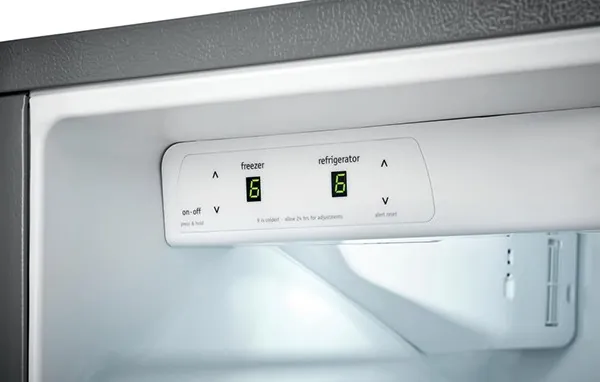
The third is the control setting. A dial turned to a low number, or a digital panel that got bumped, keeps the freezer above freezing. This is the easiest cause to fix and the first one to check.
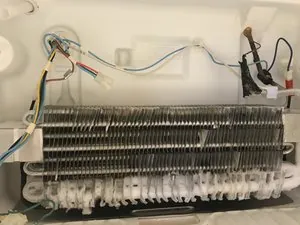
There’s also a defrost problem. Frost-free freezers run a small heater on a timer to melt ice off the coils. If that cycle fails, ice builds up behind the back panel and blocks the cold air. You won’t see it from the inside — the ice hides behind the wall.
If none of these match, the issue may be the compressor, the start relay, or a refrigerant leak. Those need a technician. A capacitor in the unit can hold a lethal charge even when unplugged, so don’t open the back panel yourself.
Check the temperature setting first
This fix is for anyone whose freezer feels cool but not cold, and whose food is soft rather than fully thawed. It costs nothing and takes a day to confirm.
The standard recommendation for a freezer compartment is 0°F. On a digital panel, set it to 0°F directly.
Here’s what to do:
- Turn the freezer control to its coldest setting.
- Leave the door shut for 24 hours. Don’t peek every hour — each open door adds warm air.
- After 24 hours, put a fridge thermometer between two frozen items. Read it without holding it in your hand.
- If it reads 0°F or below, the setting was the problem. Dial it back to 0°F and leave it.
Move on to the door and the vents.
One note: a freezer that’s packed full recovers slower than a half-empty one. If yours is stuffed, give it 48 hours before you judge the result.
Clear the vents and reload the shelves
This fix is for freezers that run constantly but stay warm, especially ones that are very full. It’s about airflow, not temperature.
Cold air in a Frigidaire freezer comes out of vents, usually at the back or the top. It needs a clear path to travel down and around. When food blocks that path, the thermostat sensor sits in warm air and the compressor never gets the signal to push harder.
Do this:
- Pull everything out and look for the vent openings. They’re often slots or a grille near the back wall.
- Keep at least 2 inches of space in front of every vent. No bags, no boxes, no ice trays pressed against them.
- Don’t stack food above the top shelf line if your model has a marked limit.
- Leave a gap between items so air can move sideways too.
If the whole cabinet feels the same temperature, airflow wasn’t your problem.
A full freezer is actually more efficient than an empty one — the frozen mass holds the cold. But “full” means packed with cold food, not jammed against the vents. Those are different things, and mixing them up is a common mistake.
Test and reseal the door gasket

This one is for freezers with frost along the door edge, or a door that doesn’t pull shut on its own. It’s the fix for a unit that runs nonstop and never gets cold enough.
The gasket is the rubber strip around the door. When it’s dirty, cracked, or bent, warm room air leaks in all day. The compressor works harder and still loses.
The dollar-bill test tells you if the seal is bad:
- Open the door and place a dollar bill across the gasket, half in and half out.
- Close the door and try to pull the bill out.
- If it slides out easily, the seal is weak at that spot. Test four spots — top, bottom, and both sides.
If the bill pulls free, clean the gasket first with warm soapy water. Grease and crumbs stop the rubber from sealing. If it’s torn or permanently bent, replace it.
You can also soften a slightly bent gasket with a hair dryer on low, held a few inches away. Warm it, then close the door and let it cool in place.
If the door frame itself is warped or the hinge is loose, that’s a repair job. A warped door won’t seal no matter how new the gasket is.
When to call a technician
Call a technician when the freezer runs but the back wall never gets cold, or when you hear clicking from the back every few minutes. That points to the compressor, the start relay, or a refrigerant leak — none of which you can safely fix at home.
This is the harder-case fix, and it’s worth the cost only in some situations. A sealed-system repair on a freezer still under warranty is usually worth doing. On a basic chest freezer that’s many years old, the repair can cost more than a new unit. Get a quote before you agree to anything.
Say this to the technician: the freezer runs constantly, the vents are clear, the gasket is good, and the setting is at 0°F. That saves a diagnostic visit.
Don’t open the back panel yourself. The capacitor can hold a lethal charge even with the unit unplugged, and the refrigerant lines are under pressure. This is technician-only work.
If your freezer is under a Frigidaire warranty, call Frigidaire support first. A repair by an unauthorized person can void the warranty.
What not to do when your freezer won’t freeze
- Turn it off and on again to “reset” it. A freezer has no reset that fixes a warm cabinet. Power cycling just adds hours of warm-up time and lets food thaw further.
- Crank the dial to the coldest setting forever. Running at maximum all the time wears the compressor and wastes energy. Use the coldest setting to test, then set it back to 0°F.
- Put warm food straight in. A big pot of warm soup raises the whole cabinet’s temperature and can push everything above freezing for hours. Cool food first.
- Chip ice off the back wall with a knife. You can puncture a refrigerant line. That’s a permanent, expensive failure. Let it defrost naturally or use a plastic scraper only.
- Assume frozen food is still safe because it looks frozen. If the freezer sat above 40°F for more than a few hours, the food may not be safe. When in doubt, throw it out.
Stop the problem coming back
Keep the freezer at 0°F, keep the vents clear, and check the gasket twice a year. Those three habits prevent most repeat failures. The table below sets what people often do against what works better.
| If you’re doing this | Do this instead | Why |
|---|---|---|
| Packing food against the back wall | Leave 2 inches in front of every vent | Cold air can’t circulate when vents are blocked |
| Setting the dial to the coldest number | Set it to 0°F and leave it | Max setting wears the compressor and wastes power |
| Ignoring frost along the door edge | Clean and test the gasket twice a year | Frost at the edge means warm air is leaking in |
| Slamming the door shut | Let it close on its own or push gently | A hard slam bends the gasket out of shape |
| Putting warm leftovers straight in | Cool them first, then freeze | Warm food raises the whole cabinet’s temperature |
| Never checking the temperature | Keep a thermometer inside | You can’t tell 0°F from 20°F by touch |
Frequently asked questions
How long does a Frigidaire freezer take to get cold after being plugged in?
A freezer usually reaches 0°F in about 24 hours, assuming a normal room temperature and a half-full cabinet. A completely empty freezer gets there faster; a packed one can take 48 hours. Don’t add food until it holds 0°F. If it’s still warm after two full days, the problem isn’t the wait time.
Why is my Frigidaire freezer running but not freezing?
The most common reason is blocked airflow or a warm control setting. Check that nothing covers the vents, then confirm the control is at 0°F. If both are fine and it’s still warm, the door gasket or the defrost system is the likely cause. A compressor or refrigerant fault is possible but less common.
Is it safe to eat food from a freezer that stopped freezing?
It depends on how warm it got and for how long. Food that stayed at 40°F or below, or was still partly frozen with ice crystals, is usually safe to refreeze. Food that sat above 40°F for more than a few hours should be thrown out. The USDA FoodSafety.gov “Food Safety in a Disaster or Emergency” page covers the exact rules.
Can I fix a Frigidaire freezer myself?
Yes, for the common causes. You can adjust the setting, clear the vents, clean or replace the gasket, and defrost the unit. You can’t safely fix a compressor, a start relay, or a refrigerant leak — those need a trained technician. Never open the back panel, because the capacitor can hold a lethal charge.
Why does my Frigidaire freezer have frost inside?
Frost inside usually means moist air is getting in. That’s a door gasket problem or a door left open. It can also come from putting warm, uncovered food inside. Heavy frost behind the back panel points to a failed defrost cycle, which is a technician job.
How often should I check my freezer temperature?
Check it once a month with a thermometer, and any time food feels softer than usual. A freezer that’s drifting warm gives you no warning until food starts to thaw. A monthly check takes ten seconds and catches the problem before you lose a full load of food.
What temperature should a Frigidaire freezer be set to?
Set it to 0°F. That’s the standard recommendation for freezers. Anything above 10°F starts to affect food quality, and above 40°F is a safety concern. On a dial model with numbers instead of degrees, the middle-to-cold range usually lands near 0°F — confirm with a thermometer.
Conclusion
A freezer that won’t freeze is almost always an airflow, door, or setting problem, and you can check all three in an afternoon. Start with the setting, clear the vents, and test the gasket with a dollar bill. If the back wall stays warm after that, it’s time to call a technician — and that’s the point where a DIY fix stops being safe.